


Psoas Release Massage: What It Is and How to Do It Safely

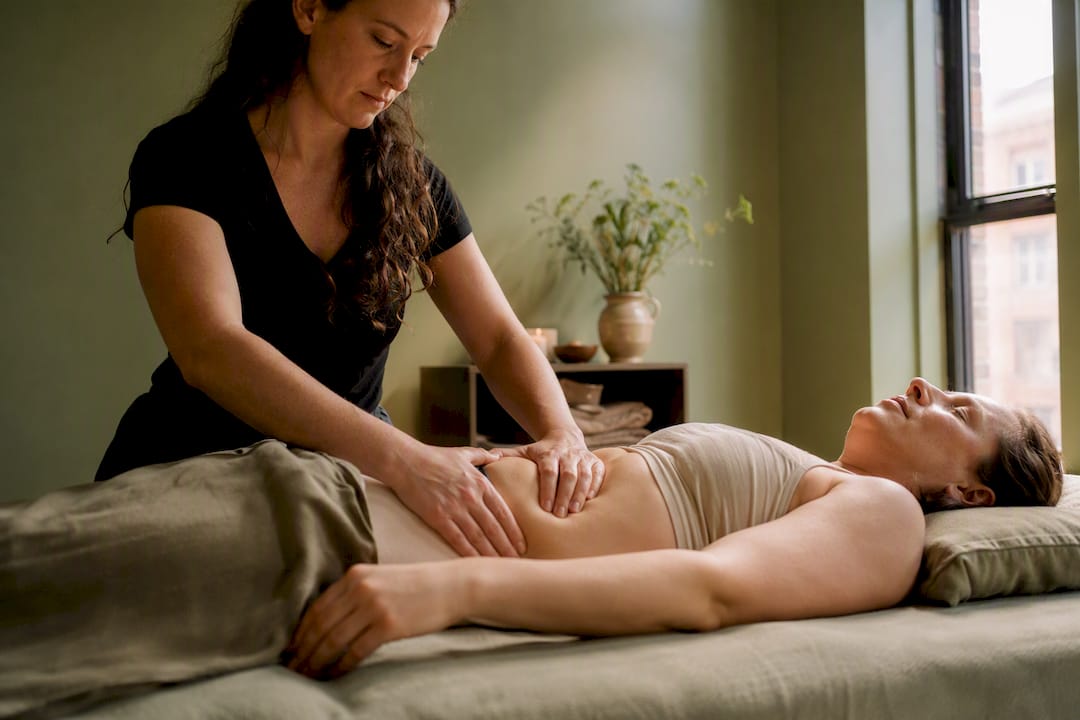
Psoas release massage can genuinely ease deep hip and low-back tension, but it works best as gentle, breath-timed pressure, never forceful digging into the abdomen. If you’re dealing with tight hips or nagging low-back tension, start with the breathing-assisted self-techniques below, and book a session with a trained therapist at Intuitive Balance Massage if pain persists, you’re unsure how to locate the muscle, or you have any of the screening flags covered further down.
TL;DR:
Gentle, breath-timed pressure during psoas release can alleviate tension, but forceful digging into the abdomen is unsafe and ineffective.
Manual techniques like strain-counterstrain and myofascial release should be performed cautiously, with checkpoints and clear consent, especially near the blood vessels.
Self-massage is helpful only when done slowly, on an empty stomach, and avoiding pregnant, post-surgery, or blood-thinning individuals, with sharp sensations as a warning.
Combining psoas release with targeted stretching, diaphragmatic breathing, and light strengthening exercises produces more lasting improvements.
Patients with sharp, pulsing, or unrelated symptoms should seek medical evaluation before attempting manual psoas work or self-release.
Table of Contents
What Is Psoas Release Massage and Who Benefits From It?
The psoas major runs from your lower spine, through the pelvis, and attaches near the top of the femur, making it one of the only muscles that directly connects your spine to your leg. It flexes the hip, helps stabilize the lumbar spine, and works constantly during sitting, walking, and standing back up. That constant workload is exactly why so many desk workers, runners, and people who sit for long commutes end up with a psoas that feels locked up.
Tight or overworked psoas tissue tends to show up as a deep ache in the low back, a pulling sensation in the front of the hip or groin, or a noticeable limit in how far you can extend your hip backward, like at the end of a lunge. Some people describe it as a knot they can’t quite reach, sitting somewhere behind the belt line.
The research on manual psoas work is more encouraging than most soft-tissue claims. A clinical trial found that diaphragmatic and iliopsoas myofascial release significantly reduced pain and increased lumbar range of motion compared with control treatments in people with chronic low back pain. Separately, an RCT on the iliopsoas strain-counterstrain technique combined with exercise produced pain reductions that crossed the threshold clinicians consider meaningful, with noticeable gains by the sixth session. An observational clinical audit of remedial psoas massage reported that 92% of patients who completed treatment had full symptom resolution, with most maintaining that improvement at follow-up.
None of that means psoas release is a guaranteed fix. These studies point to real, measurable improvement in pain and mobility for many people, not a cure, and the strongest results came when manual work was paired with exercise rather than used alone. A realistic frame looks like this:
Manual psoas techniques can reduce localized tension and improve short-term hip extension range.
Results tend to build over several sessions rather than appearing after one.
Combining release work with targeted stretching and strengthening outperforms release alone.
Not everyone responds the same way; body type, activity level, and how long the tension has been present all matter.
How Do Therapists Perform Professional Psoas Release?
In a clinical setting, psoas work looks nothing like blunt digging into the stomach. Trained therapists rely on a handful of specific, evidence-informed methods and they build in checkpoints along the way rather than pushing straight into deep pressure.
Strain-counterstrain (SCS) is one of the more research-backed approaches. The therapist locates a tender point, commonly around two inches medial and inferior to the front hip bone (the ASIS), then positions the hip in flexion, abduction, and external rotation until the tissue softens under light contact. That position of ease is held for about 90 seconds and repeated two to three times per side. The RCT on iliopsoas SCS used this exact protocol and reported clinically meaningful pain relief by session six.
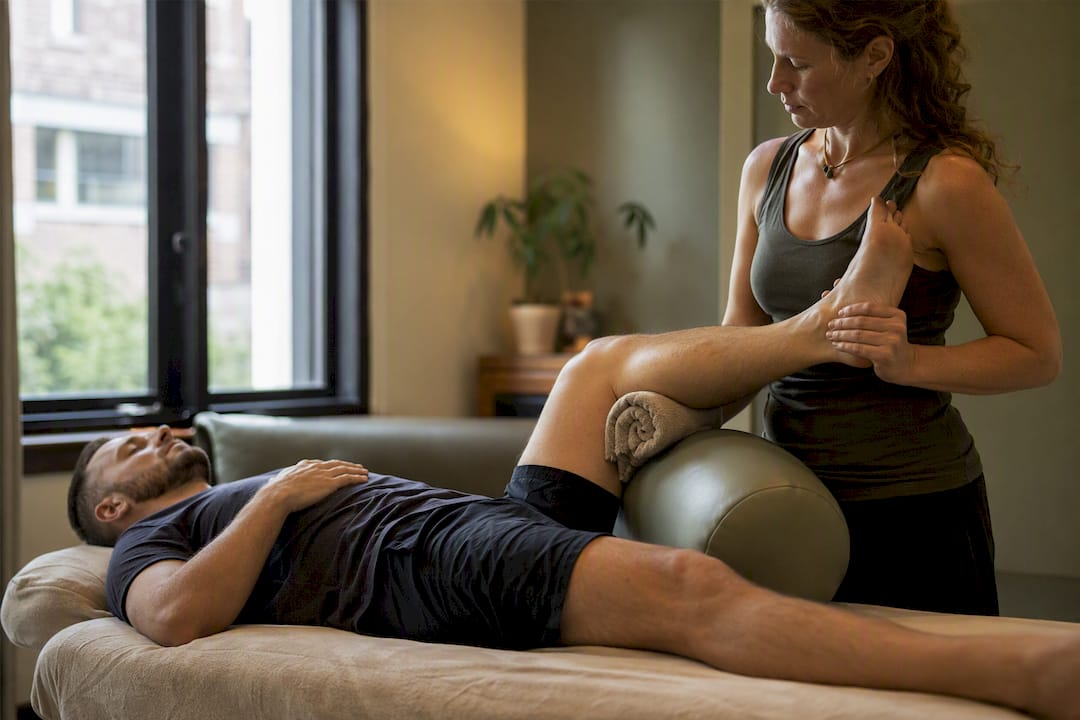
Myofascial release (MFR), often applied to both the diaphragm and the iliopsoas, uses sustained, low-load pressure rather than kneading. The therapist follows the tissue’s release pattern instead of forcing it, which is part of why the MFR study on chronic low back pain showed improved range of motion alongside reduced pain.
Muscle energy technique (MET) asks the client to gently push against light resistance from the therapist, then relax, which uses the body’s own reflexes to reduce muscle guarding before any direct pressure is applied.
For direct trans-abdominal palpation, therapists follow a specific sequence:
Assess first. Check hip extension range, palpate for tenderness, and ask about surgical history, pregnancy, or digestive conditions before any hands-on work begins.
Get clear consent. Explain exactly where hands will go and why, since abdominal work feels different from typical back or shoulder massage.
Work with the breath. The therapist sinks in slowly as the client exhales, staying lateral to the umbilicus and never pressing on a pulsing sensation, which signals a blood vessel rather than muscle.
Recheck immediately. After a release, the therapist retests hip extension or asks the client to notice any change in sensation.
Send you home with a plan. Nearly every session ends with one or two stretches or breathing cues to reinforce the work between visits.
This caution isn’t excessive. Practitioner guidance from ABMP is explicit that psoas work must stay gentle and breath-assisted because of the major blood vessels and organs sitting close to the muscle. A separate critique from Science of Massage warns specifically against indiscriminate direct compression, recommending indirect access points, like the side of the inguinal ligament, as a safer default for anyone without advanced training.
Pro Tip: If a therapist presses into your abdomen and asks you to hold your breath, that’s a signal to speak up. Good psoas work moves with your exhale, never against it.
Therapists escalate to referral when pain is sharp rather than achy, when there’s a pulsatile sensation under the fingers, or when a client reports symptoms unrelated to muscle tension, like fever or unexplained weight loss. Those cases call for a physician, not more massage pressure.
How to Release the Psoas Muscle Yourself
Self-massage can genuinely help between professional sessions, but the abdomen is not the place to improvise. Work slowly, breathe deliberately, and stop the moment something feels sharp rather than achy.
Before you start, run through a quick checklist: skip this if you’re pregnant, within a few months of abdominal surgery, or on blood thinners; work on an empty stomach or at least an hour after eating; find a quiet spot where you can lie down and relax your abdominal wall completely, since a guarded stomach makes it nearly impossible to reach the muscle safely.
Technique 1: Gentle trans-abdominal finger release
Lie on your back with knees bent and feet flat, which slackens the abdominal wall.
Locate a spot about two inches in and two inches down from your hip bone (the ASIS), on the same side you feel tightness.
Rest your fingertips there lightly. Do not press yet.
As you exhale slowly through pursed lips, let your fingers sink in gradually, following the breath rather than pushing against it.
Hold gentle contact for 30 to 60 seconds, breathing normally, then release slowly on an inhale.
Stop immediately if you feel any pulsing under your fingers or anything sharper than a dull, achy pressure.
Technique 2: Side-lying iliacus access and standing lunge
If direct abdominal work feels uncomfortable or you’d rather avoid it entirely, this indirect option targets the same region from a safer angle.
Lie on your side with knees bent, and use the pads of your fingers to press gently along the inside edge of your hip bone, working with your breath the same way as Technique 1.
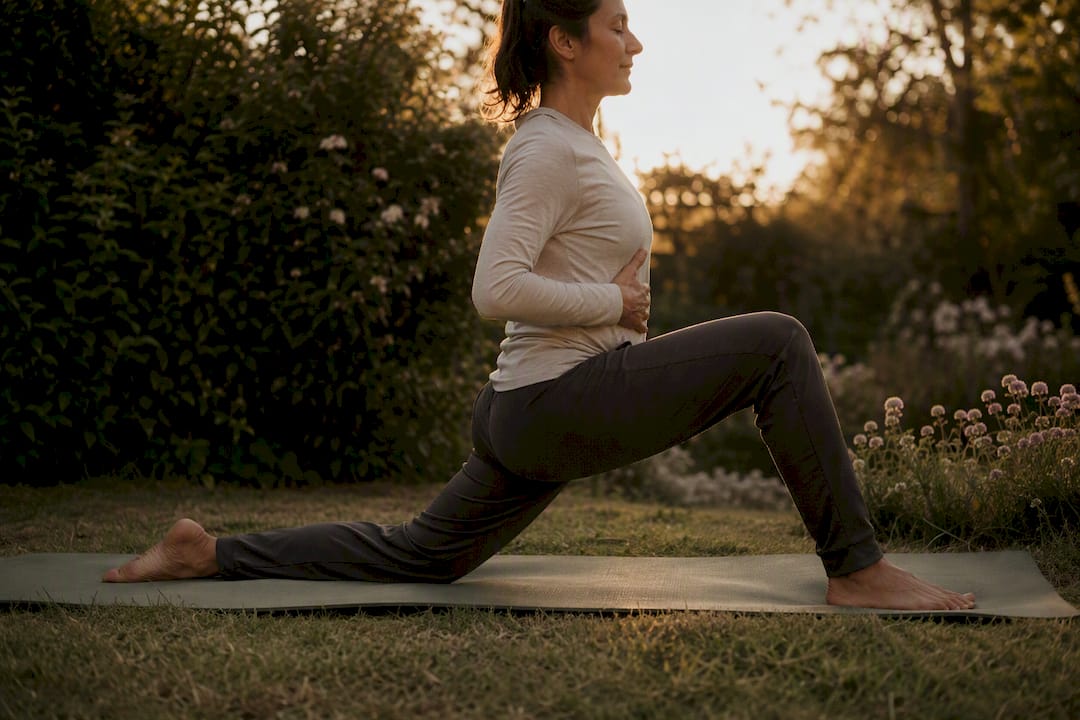
Follow with a kneeling lunge stretch: back knee down, front foot forward, gently shift your hips forward until you feel a stretch in the front of the back hip, holding 20 to 30 seconds.
Add a soft ball (like a small pilates ball) placed just below the front hip bone while lying face down, letting your body weight apply light pressure as you breathe.
Technique 3: Tool-assisted anterior hip release
A soft ball offers more consistent pressure than fingers, especially if hand fatigue is an issue.
Place a soft, low-density ball on the floor and lie face down with the ball positioned just medial to your hip bone.
Let your body weight rest into it gradually, breathing slowly, for no more than 60 to 90 seconds per spot.
Progress to a firmer ball only after several sessions feel comfortable with the softer one.
Never use a hard lacrosse ball or similar tool directly on the abdomen. That level of firmness belongs on larger muscles like the glutes, not near the psoas.
Afterward, retest your hip extension by stepping into a gentle lunge and noting whether it feels looser than before. Follow with light stretching rather than jumping straight into intense exercise.
When Should You Screen Before Trying Psoas Release?
A simple version of the Thomas test gives you a rough read on hip flexor tightness before you start any release work. Lie on your back at the edge of a bed or table, pull one knee to your chest, and let the other leg hang off the edge. If that hanging leg doesn’t lower toward the table or the knee stays notably bent, it suggests some hip flexor tightness, including the psoas. This isn’t a diagnostic tool, just a rough gauge to help you decide whether targeted stretching and gentle release make sense for you.
Certain histories call for extra caution or a professional therapist instead of self-treatment:
Recent abdominal or pelvic surgery, including C-sections, within the past several months.
Current pregnancy, at any stage.
Blood thinner use or a diagnosed clotting disorder.
Inflammatory bowel conditions or a history of abdominal aneurysm.
Any unexplained abdominal mass or lump you haven’t had evaluated.
Stop self-treatment and seek medical review if you notice fever alongside abdominal discomfort, sudden severe or localized abdominal pain, numbness or weakness spreading down the leg, or a pulsing sensation under your fingers. These aren’t muscle-tension signals, and they need a doctor’s evaluation rather than more massage.
If any of the precautions above apply to you, lean on indirect techniques, like the side-lying iliacus approach or gentle stretching, and skip direct abdominal pressure entirely. A trained therapist can assess your specific situation more precisely than any at-home checklist.
Breathing and Stretches That Make Psoas Release Last
Release work fades fast if you don’t follow it with something that reinforces the new range of motion. Diaphragmatic breathing does double duty here: it helps you access the psoas more safely during release, and it calms the nervous system enough to actually let the muscle soften rather than guard against your touch. Practitioner guidance from ABMP points to this breath-driven down regulation as central to why gentle technique outperforms forceful pressure.
To practice it, lie down with one hand on your belly, inhale through your nose so your belly rises, then exhale slowly through your mouth for longer than the inhale. Do this for three to five breaths before and during any release work.
Pair that breathing with a short daily routine:
Modified Thomas stretch, 20 to 30 seconds per side, kneeling with one knee down and gently sinking your hips forward.
Kneeling hip flexor stretch with a slight posterior pelvic tilt added, which targets the psoas more directly than a standard lunge.
Glute bridge or glute activation, 10 to 15 reps, since a stronger glute reduces how much your psoas has to compensate during standing and walking.
Five minutes of this daily, alongside occasional release work, tends to hold gains better than release alone. Once hip extension feels consistently looser, adding light strength training for the low back and hips helps lock in that mobility rather than letting it slide back within a few days.
How Intuitive Balance Massage Approaches Psoas Tension
At Intuitive Balance Massage in downtown Raleigh, psoas-related tension gets the same careful, assessment-first approach described throughout this guide. Sessions start with a conversation about where you feel tightness, followed by a basic hip extension check and gentle palpation to locate the specific areas holding tension, rather than guessing and applying deep pressure everywhere.
From there, therapists use breathing-assisted manual techniques, working with your exhale rather than against it, and reassess as they go. A session typically closes with a short stretch or two you can repeat at home to extend the benefit between visits.
What that looks like in practice:
Intake includes questions about surgical history, pregnancy status, and any digestive conditions before any abdominal-area work begins.
Techniques stay indirect or gentle by default, escalating only with clear communication and consent.
Every session pairs hands-on work with a simple take-home stretch or breathing cue.
Sessions run within the clinic’s standard customized therapeutic and deep tissue offerings, adjusted to your specific tension pattern.
If you’re dealing with tight hips that seem connected to broader mobility limits, it’s worth reading how tight hips affect movement throughout the body before your visit, so you can describe your symptoms clearly during intake.
When I’d Choose Direct Psoas Work Over Indirect Techniques
My rule of thumb is simple: if you can point to the exact spot that’s tight and describe the sensation as achy rather than sharp, gentle direct work is reasonable to try, whether at home or in a clinic. If you’re guessing at the location, dealing with a recent surgery or pregnancy, or the discomfort has a pulsing or electric quality, indirect techniques are the safer starting point every time.
What stands out most in the research isn’t that psoas release works. It’s that the studies showing real benefit, the SCS trial and the MFR study both, used slow, breath-timed, low-force protocols, not deep digging. The therapists getting results are the patient ones, not the aggressive ones. That’s a genuinely counterintuitive finding for anyone expecting a massage that “really gets in there” to feel like the most effective option.
If you’ve tried gentle self-release for a couple of weeks without much change, that’s usually your signal to book a session rather than push harder on your own.
— John
Book a Psoas-Focused Massage Session in Raleigh
If self-release hasn’t fully resolved your hip or low-back tension, a customized deep tissue or therapeutic session at Intuitive Balance Massage lets a trained therapist assess and work the area with the same breath-timed, safety-first approach covered throughout this guide, without you having to guess at hand placement or pressure. A 60-minute session gives enough time for a proper assessment, focused release work, and a take-home stretch plan tailored to what your therapist finds.
When you book, mention your specific hip or low-back concern, note any prior abdominal surgery, and flag your pregnancy status if applicable, so your therapist can plan the session appropriately from the start. New clients can take advantage of the $60 introductory rate to try a session before committing to ongoing care. Schedule your appointment today and let a trained therapist take it from here.
Sources
For readers who want to dig into the research behind these techniques, the iliopsoas strain-counterstrain RCT and the diaphragmatic and iliopsoas myofascial release study offer the strongest controlled evidence on pain and mobility outcomes. The observational clinical audit provides real-world outcome data from a treated cohort. For safety guidance straight from practicing therapists, see ABMP’s practitioner overview and the Science of Massage critique on abdominal technique risks.
FAQ
What is the fastest way to release the psoas?
There’s no true shortcut, but breathing-assisted pressure held for 30 to 60 seconds on an exhale, paired with a hip flexor stretch right after, tends to produce the quickest noticeable change in a single session.
Can a massage therapist release psoas tension?
Yes. Trained therapists use techniques like strain-counterstrain and myofascial release, both backed by clinical research showing reduced pain and improved lumbar mobility, and they know how to work safely around the abdomen’s blood vessels and organs.
What does it feel like when your psoas is releasing?
Most people describe a deep, achy pressure that gradually softens as you breathe, sometimes with a brief warm or tingling sensation; sharp pain or pulsing is not part of a normal release and means you should stop.
What is stored in a tight psoas?
The psoas doesn’t store anything measurable in a clinical sense, but many people notice emotional or stress-related sensations release alongside physical tension, which practitioners often attribute to the muscle’s role in the body’s stress response rather than any literal storage.
How often should I do psoas release work?
Gentle self-release two to three times a week, alongside daily breathing and stretching, is a reasonable starting frequency; professional sessions are typically spaced one to two weeks apart based on how your body responds.


Comments